Objectives
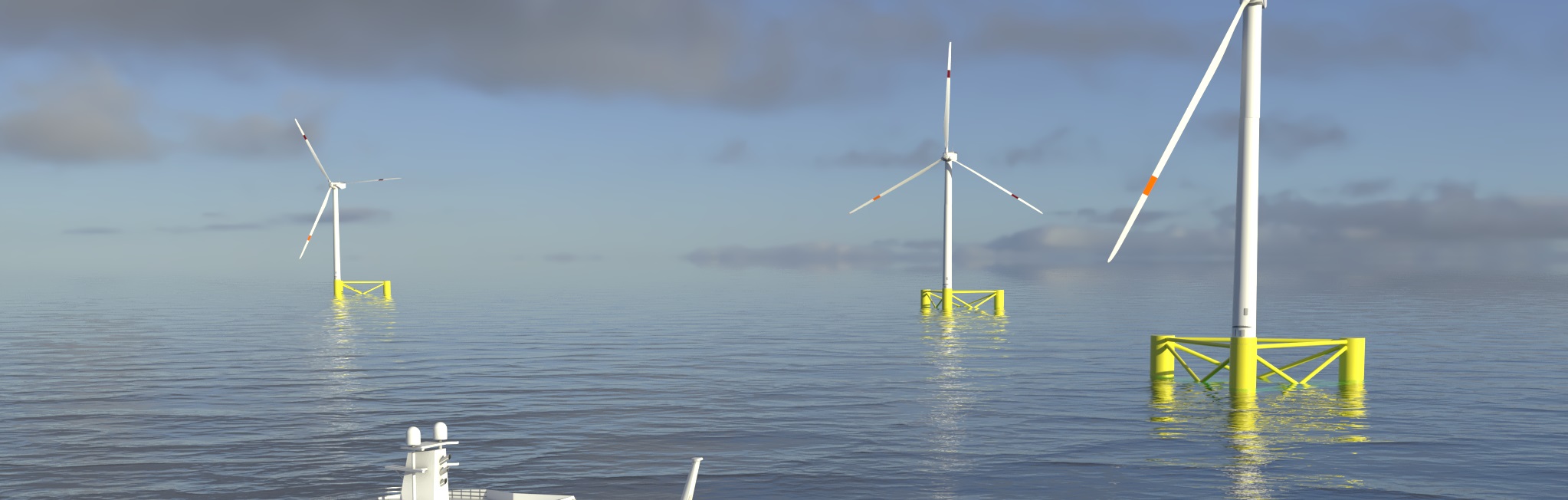
The e-PROA project aims to solve the needs identified in the Operation and Maintenance of floating wind farms, promoting functionality, sustainability and circular economy, contributing to the creation of a modern and competitive Spanish naval sector, adjusted to the global needs and dynamics of the sector in the 21st century.
DIGITAL TWIN WITH PREDICTIVE IA
With the implementation of a Digital Twin of the installation and with predictive models based on Artificial Intelligence (AI), the aim is to optimise operation and maintenance strategies. The development of subrogated models with deep learning (DLSM), which include PiNNs (Physics informed Neural Networks) and NOs (Neural Operators), of the different parts of the floating structure and allow the necessary precision and speed to estimate the useful life, detect anomalies and predict failures in an integrated way in the digital twin.
This integrated architecture and design with AI allows to leverage the digital twin by reducing OPEX and maximising the energy production of the unit, as well as automating the operation, maintenance and control processes of the floating wind farm.
ECO-SOV vessel
The maintenance operations of today’s (fixed) wind farms are mainly carried out with two types of vessels, CTVs (Crew Transfer Vessels) or SOVs (Service Operation Vessels). The choice of one or the other depends mainly on the metocean conditions, mainly on the average significant wave height. CTVs are smaller vessels and are limited to operating in seas with a wave height of more than one metre, while SOVs are larger and can operate in waves of up to 2.5 metres. Thus, for installations in the Baltic where the units are very close to shore and in sheltered areas, CTVs allow access to the units 70% of the time, making maintenance operations cheaper. However, this is not feasible in areas such as the North Sea or the Atlantic, where environmental conditions mean that SOVs have to be chosen. These vessels are generally over 80 m in length, much more expensive and polluting, but allow access to the platform around 50% of the time.
The e-PROA project addresses this problem through the development of a new eco-SOV vessel for the maintenance of floating offshore wind farms. This vessel is innovative in itself as it seeks to ensure, with a reduced length, accessibility for 90% of the time to the units of a floating wind farm in the Atlantic. This is achieved by ensuring accessibility to the platforms in seas of up to 3.5 m significant wave height. This will be achieved by using cycloidal thrusters, a technology that simultaneously allows instantaneous motion cancellation (balancing) and a position-holding system (DP2 level), which enables the safe transfer of personnel in these sea states. At the same time, in the design of the ECO-SOV ship, priority has been given to zero-emission propulsion systems through the development of a hybrid propulsion plant based on ECO fuels such as green methanol and with the autonomy required for this type of vessel.